

Rugged Outdoor Lifestyle Clothing Brands: 10 Picks
Table of Contents
- What Counts as Rugged Outdoor Lifestyle Clothing
- The Best Outdoor Clothing Brands for Frontier Style
- Durable Outdoor Clothing: What Holds Up Wash After Wash
- Sustainable Outdoor Clothing Brands and Responsible Manufacturing
- Hiking Clothing Brands and Layering for Mountain Conditions
- Hoodies, Sweatshirts, and Rodeo-Ready Layers
- Fit, Sizing, and Cost Per Wear
- Frequently Asked Questions
Last Updated: October 21, 2026
What Counts as Rugged Outdoor Lifestyle Clothing
Rugged outdoor lifestyle clothing is apparel built to survive real work and real weather while still looking like something you'd wear off the trail. It sits between technical gear and everyday wear: durable enough for brush, rock, and cold mornings, casual enough for a diner counter afterward.
The distinction matters. Outdoor apparel is engineered for a single activity. Rugged clothing is engineered for a life. That means heavier fabrics, prints that survive washing, and designs that carry a story. If a piece only works on a summit, it isn't lifestyle clothing.
Here's what we look for, and what we'd tell a friend to check before buying anything:
- Fabric weight and hand feel. Lightweight cotton breathes; heavier cotton and cotton-poly blends hold shape and warmth.
- Print durability. A graphic that cracks after five washes is decoration, not apparel.
- Construction details. Tubular knit, taped shoulders, and ribbed collars resist stretching.
The Best Outdoor Clothing Brands for Frontier Style
The best outdoor clothing brands for frontier style combine authentic design with construction that survives repeated washing, and the fastest way to choose between them is a consistent comparison on use, materials, fit, and price. Here are the criteria we apply, then how our line stacks up.
The four criteria that separate rugged lifestyle brands
- Intended use. Is the piece built for a specific sport or for the crossover life of trail, camp, and town? Lifestyle clothing should work across all three.
- Materials and construction. Heavier cotton, cotton-poly blends, and bonded graphics outlast lightweight fashion cotton with heat-transfer prints. Tubular knit bodies, taped shoulders, and ribbed collars reduce the failure points that show up first.
- Fit and sizing. A true-to-size unisex cut is the most versatile starting point, but brands that publish garment measurements and flag pieces that run small save you a return.
- Price and cost per wear. A $25.99 long sleeve worn weekly for two years costs pennies per wear; a cheaper tee that cracks in a month costs more per outing.
How our line compares on those criteria
We rank our picks below by how well each handles the crossover test, starting with the ones we'd hand someone first.
Alaskan Wildlife Survival Guide Long Sleeve Tee ($25.99). Our top pick and most-recommended piece.

Fierce Wolf Long Sleeve Tee ($25.99) and Fierce Bear Long Sleeve Tee ($25.99). Two designs, one idea: wear your wild side.
Moose Don't Care & Neither Do I Long Sleeve Tee ($25.99). Our humor pick and the one that gets the most comments.
What to compare before you buy from any brand
When you're looking at a brand we don't carry, ask the same four questions. Check fabric weight and fiber content, not just the marketing name. Look for a stated print method (DTG or DTF bonded graphics resist cracking better than heat-transfer vinyl). Confirm whether the fit is true to size or runs small. Finally, divide the price by the number of wears you realistically expect; that number, not the sticker price, is the honest comparison.
Durable Outdoor Clothing: What Holds Up Wash After Wash
Durable outdoor clothing holds up because of three things: fabric weight, print method, and seam construction. Miss any one and the garment fails early.
Start with fabric. Our Chaos in Boots Alaska Rodeo 2026 Long Sleeve Tee ($25.99) uses medium-weight 6.0 oz/yd² eco-friendly heavier cotton for a substantial, vintage feel with warmth but no bulk; the Chaos in Boots Alaska Rodeo 2026 T-Shirt ($22.99) goes lighter with 100% ring-spun cotton at 153 g/m² for breathable summer wear.
Then look at construction. Tubular knit means no side seams, so there's less to rub and less to fail.
Print matters most for graphics. DTG and DTF printing, done right, bonds ink into the fabric rather than sitting on top of it.
| Durability Factor | What to Check | Why It Matters |
|---|---|---|
| Fabric weight | 6.0 oz/yd² or heavier for cool weather | Holds shape, resists thinning |
| Print method | DTG/DTF bonded graphics | Resists cracking and fading |
| Seam style | Tubular knit, no side seams | Less friction, fewer failures |
| Collar build | Ribbed with shoulder tape | Prevents stretch-out |
| Care routine | Cold wash, low dry | Extends print life |
Sustainable Outdoor Clothing Brands and Responsible Manufacturing
Sustainable outdoor clothing brands focus on materials and sourcing you can actually trace, not just a green label, and the way to tell the difference is to read the fiber content, the certification marks, and the repair and warranty terms before you buy. Four buckets to check: materials, certifications, production model, and end-of-life support.
Materials: what the fabric is actually made of
Fiber content drives both durability and environmental impact. Ring-spun cotton is smoother and stronger than standard open-end cotton, so it resists pilling longer. Cotton-poly blends trade some breathability for shape retention and faster drying.
On our side, the Chaos in Boots Alaska Rodeo 2026 T-Shirt uses 100% ring-spun cotton at 153 g/m² and carries Oeko-Tex certification. The Rodeo 2026 Long Sleeve Tee uses eco-friendly heavier cotton at 6.0 oz/yd².

Certifications: third-party marks versus in-house badges
A certification is only useful if an independent body issues it and you can look it up. Oeko-Tex, for example, tests for harmful substances in textiles and is a commonly cited standard you can verify (OEKO-TEX® STANDARD 100).
For broader context on textile standards, the Federal Trade Commission's guidance on green claims explains what marketers may and may not say about environmental benefits, including the difference between a general environmental benefit claim and a specific, substantiated one.
Production model: made-to-order versus warehouse inventory
Responsible manufacturing also means made-to-order production, which is how we operate. Nothing sits in a warehouse waiting to be discounted or discarded. That can mean a short wait for shipping, but it cuts the waste from overproduction and end-of-season markdowns. When you compare brands, ask whether they produce to demand or to forecast.
Alaskan Wildlife Survival Guide Long Sleeve Tee →
End-of-life: repair, warranty, and cost per wear
The most overlooked sustainability question is what happens when a garment wears out. Brands offering repair programs or lifetime warranties extend product life, which lowers cost per wear and keeps textiles out of the waste stream.
Cost per wear ties this together. A $25.99 long sleeve worn weekly for two years costs pennies per wear; a cheaper tee that cracks in a month costs more per outing, even at half the price.
Our advice for judging any brand in this space:
- Ask what the fabric is made of, specifically, including fiber percentages.
- Look for third-party certification you can verify, not in-house badges.
- Check whether the maker discloses production locations and whether production is made to order.
Hiking Clothing Brands and Layering for Mountain Conditions
The best hiking clothing brands build around layering, because mountain conditions change faster than you can change clothes. A system beats a single garment every time.
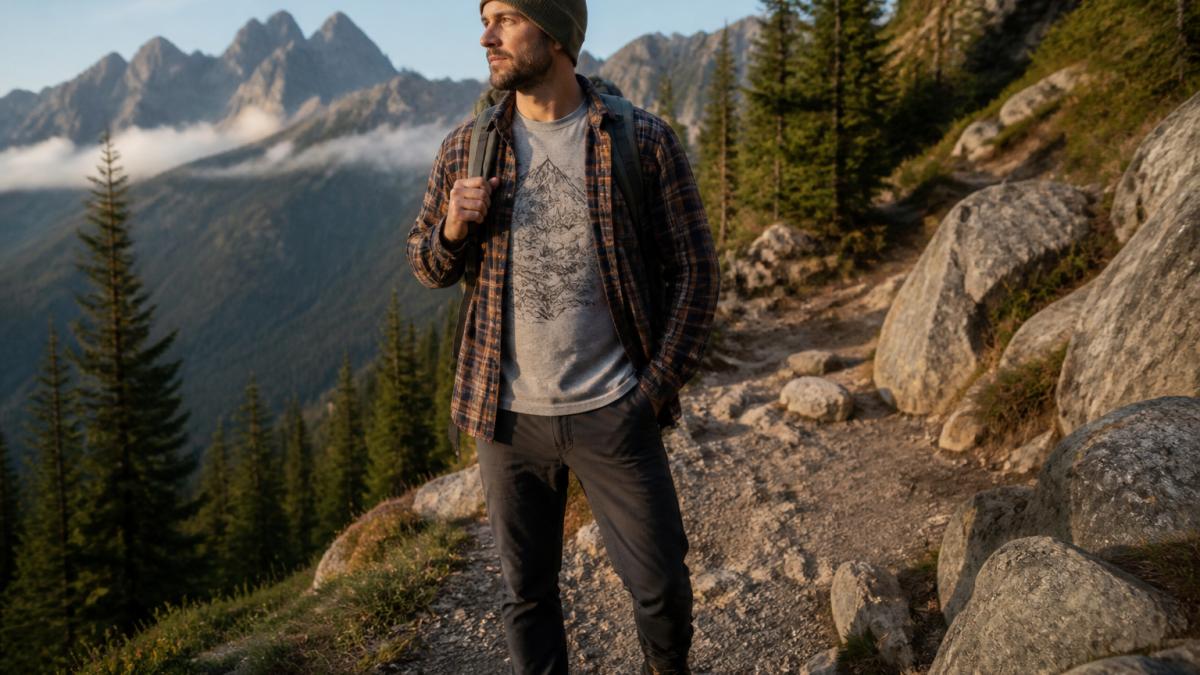
Here's the layering approach we'd use for a cool-weather day hike:
- Base layer: a breathable long sleeve like the Caribou Courage Long Sleeve Tee ($25.99), soft against the skin with warmth for cool starts.
- Mid layer: a crewneck or hoodie for insulation you can shed. The Caribou Courage Sweatshirt ($29.99) or Chaos In Boots Crewneck Sweatshirt ($29.99) both layer well.
- Outer layer: wind and weather protection, opened up as you climb and closed on the summit.
- Accessories: a hat and gloves make more difference than an extra jacket.
The principle is moisture management. Cotton next to skin is fine for cool, dry days; when you're working hard, vent before you soak through.

For safety guidance on mountain weather and trip planning, the National Weather Service's mountain weather safety resources is worth reading before any shoulder-season hike.
Hoodies, Sweatshirts, and Rodeo-Ready Layers
The Chaos in Boots Hoodie ($35.00) is our heaviest piece: a medium-heavy 8.0 oz 50/50 cotton-poly blend with a double-lined hood, color-matched drawcord, and roomy kangaroo pocket, built for muddy trails and slow mornings by a woodstove alike.
For the Western crowd, the Chaos in Boots Alaska Rodeo 2026 designs lean into rodeo energy: an eagle, a charging moose, a wolf and bear running alongside a rider, framed by mountain peaks.
Fit, Sizing, and Cost Per Wear
Most of our line uses a classic unisex fit that runs true to size: order your normal size, with one exception, the Rodeo 2026 Long Sleeve runs slightly small.
Cost per wear is the honest math. A $25.99 long sleeve worn weekly for two years costs pennies per wear.
Inclusive sizing matters here too. A true-to-size unisex cut flatters a range of body types, and our listings state the fit plainly.
| Piece | Price | Best Use | Fit Note |
|---|---|---|---|
| Alaska Rodeo 2026 T-Shirt | $22.99 | Warm-weather wear | True to size |
| Wildlife Survival Guide Long Sleeve | $25.99 | Trail and town | True to size |
| Rodeo 2026 Long Sleeve | $25.99 | Cool mornings | Runs slightly small |
| Chaos In Boots Crewneck | $29.99 | Layering | True to size |
| Chaos in Boots Hoodie | $35.00 | Cold weather | Roomy for layers |
Frequently Asked Questions
What should you look for in durable outdoor clothing?
Start with the print method and the fabric weight. A durable, fade-resistant print should survive repeated washing without cracking, and care instructions like machine wash cold and tumble dry low tell you the garment was built to be worn hard. Check construction details too: ribbed collars, shoulder tape, and tubular knit builds resist stretching and seam wear. For layering, pick pieces with enough weight to hold shape, like the 6.0 oz/yd² long sleeve or the 8.0 oz hoodie, rather than thin fabric that pills after a season.
Which rugged outdoor lifestyle clothing brands make clothes for everyday wear?
The most useful picks are the ones that work off the trail as well as on it. AK-GAL DESIGNS builds its line around that idea: graphic long sleeve tees at $25.99, crewneck sweatshirts at $29.99, and the Chaos in Boots Hoodie at $35.00 all pair with jeans, flannel, or boots. Because the designs are made to order and ship in roughly 2-4 business days, you are not digging through a mass-market rack for something that looks like everyone else's shirt.
What materials are best for rugged outdoor clothing?
It depends on the layer. For warm-weather wear and layering, 100% ring-spun cotton gives a soft, breathable feel, which is what the Chaos in Boots Alaska Rodeo 2026 T-Shirt uses at a lightweight 153 g/m². Heavier cotton, around 6.0 oz/yd², adds warmth without bulk for long sleeve tees. For cool evenings, a 50/50 cotton-poly blend like the Chaos in Boots Hoodie holds warmth and prints cleanly. Match the fabric weight to the season and how many layers you plan to wear underneath.
How should outdoor clothing fit for layering?
Buy your base layer true to size and size up on anything meant to go over it. AK-GAL's long sleeve tees and sweatshirts use a classic unisex fit that runs true to size, so they sit close enough to trap warmth without binding. The Chaos in Boots Alaska Rodeo 2026 Long Sleeve Tee is the exception: its listing notes it runs slightly small, so consider sizing up for a relaxed fit. A hoodie with a roomy kangaroo pocket and double-lined hood should clear a shirt underneath without pulling at the shoulders.
How do you care for durable outdoor apparel so the print lasts?
Wash cold, inside out, and skip the bleach. AK-GAL's care instructions call for machine washing cold at a maximum of 30C or 90F, then tumble drying low or hanging to dry. Never iron directly on a printed design, and do not dry clean the graphic pieces. Turning garments inside out protects the print from friction against zippers and other clothes in the drum. Follow those steps and a fade-resistant print keeps its boldness far longer than a heat-pressed design washed hot and dried on high.
Rugged outdoor lifestyle clothing brands earn their reputation one wash cycle at a time, and the pieces that last are the ones built with real construction behind the design. At AK-GAL DESIGNS, we make bold, authentic Alaskan-inspired apparel to order, with fade-resistant prints, true-to-size unisex fits, and fast shipping so you're not waiting weeks for gear that reflects who you are. Browse the collection and add to cart when you find the design that fits your frontier.
Leave a comment