

Buy Made to Order Graphic Apparel: 2026 Buyer's Guide
Last Updated: October 23, 2026
Quick Summary
To buy made to order graphic apparel, choose your fabric and fit, match the printing method to your artwork, and approve a proof with confirmed print dimensions before production starts. Made to order graphic apparel is printed only after you order, so expect a production window plus transit time and confirm the returns policy first.
- Cotton breathes and takes ink well; an 8.0 oz/yd² 50/50 blend holds shape better than thin 4 oz jersey.
- Direct-to-garment suits photos and one-offs with no setup cost, while screen printing gets cheaper per unit at 12+.
- Send transparent, high-resolution files and confirm print size in inches, roughly 11 to 12 inches for full-front.
- Our tees run $22.99 and sweatshirts $29.99, before print charges, shipping, and any rush fees.
- Wash inside out in cold water at max 90F, tumble dry low, and never iron over the print.
Table of Contents
- Why Made-to-Order Graphic Apparel Beats Rack Tees
- How to Choose a Graphic Tee: Fabric, Fit, and Print Placement
- Pick the Right Printing Method for Your Design
- Artwork Prep and Proof Approval Before You Order
- Men's Graphic T-Shirts and Styles That Work Off the Clock
- Made-to-Order Clothing Shipping, Returns, and Total Cost
- Caring for Printed Apparel So the Design Lasts
- Frequently Asked Questions
Why Made-to-Order Graphic Apparel Beats Rack Tees
The global T-shirt market is valued at $30.68 billion in 2026, according to Printful's T-shirt industry statistics and trends report, and graphic tees now account for more than 57% of revenue in the made-to-order apparel segment.
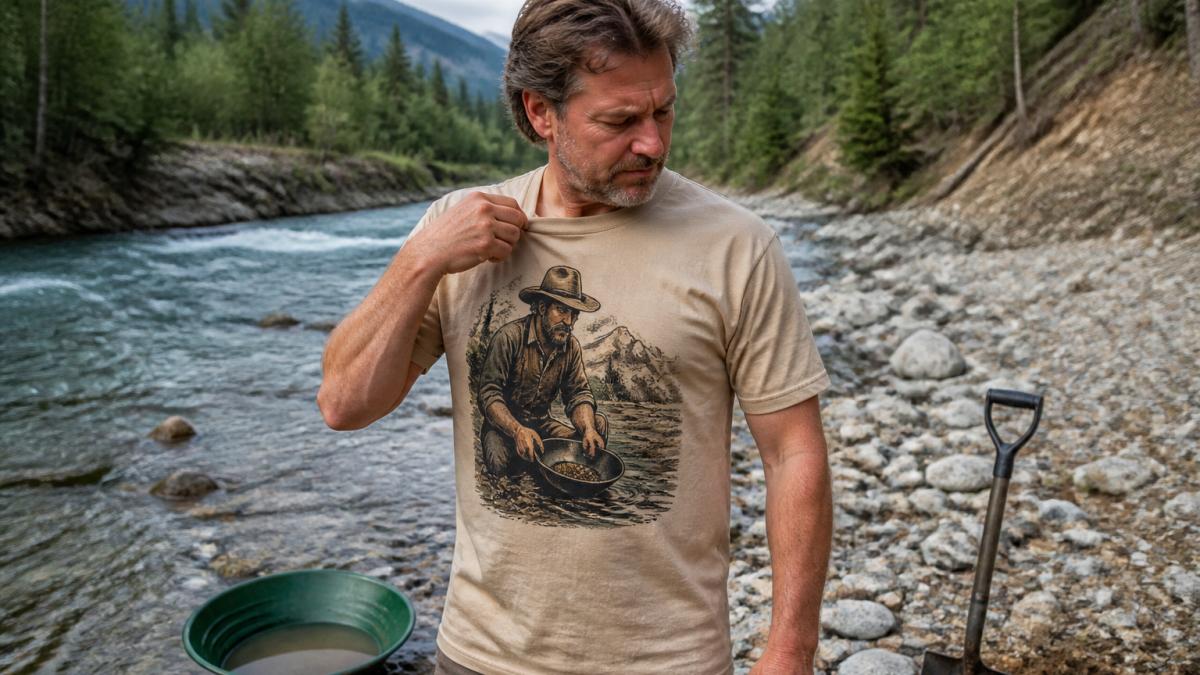
At AK-GAL DESIGNS, we build every piece around designs drawn from real gold prospecting and frontier life, printed only after you order.
Rack tees are a compromise. A buyer picked the design, the fabric, and the fit months before you walked in.
Below, we'll walk through fabric, printing methods, artwork prep, shipping, and total cost so you can order with confidence.
How to Choose a Graphic Tee: Fabric, Fit, and Print Placement
Choosing a graphic tee comes down to three decisions: what the fabric is made of, how the garment fits your body, and where the print sits. Get those right and the design does the rest.
Fabric and Garment Quality
Cotton breathes and takes ink well, which is why most print-on-demand tees start there. Blends add durability and shrink resistance.
Weight tells you more than fiber content. A medium-heavy 50/50 cotton-polyester blend at 8.0 oz/yd² holds shape through repeated washing far better than a thin 4 oz jersey. Look for double-needle stitching at the shoulders and hems, and a ribbed knit collar that springs back instead of curling.
Sizing and Fit
Check the size chart before you check the design. Measure a shirt you already like, lay it flat, and compare chest width and body length to the chart.
Classic unisex fits run true to size and suit most body types. If you're between sizes, size up for a relaxed look. Print placement matters too: a full-front print draws the eye to the chest, while a small left-chest logo keeps things understated.
Pick the Right Printing Method for Your Design
The right printing method depends on your design's color count, your order quantity, the fabric, and how the garment will be worn. Match the method to the artwork, not the other way around. Most buyers get this backward: they pick a shirt, then discover the design they want prints poorly on it.
Start With the Artwork, Not the Garment
Ask three questions before you compare methods:
- How many colors? A one-color line drawing and a full-color photograph are different problems.
- How many units? One shirt and fifty shirts justify different setups.
- What is the fabric? Cotton, polyester, and blends accept ink differently.
A design with gradients, shadows, or photographic detail needs a method that can reproduce continuous tone. A bold logo with three flat colors needs a method that lays down opaque ink and survives repeated washing.
Direct-to-Garment Printing
Direct-to-garment printing sprays water-based ink directly into the fabric, so it handles full-color, photographic, and gradient artwork without setup costs. It is the standard choice for small runs and one-off orders.
The trade-offs are real. DTG ink sits on the surface of cotton fibers, so very dark garments and very fine linework need careful proofing. On 100% cotton, DTG prints feel soft and wash reasonably well.
Screen Printing
Screen printing pushes thick ink through a mesh stencil. It is the most durable option for bold, limited-color designs and gets cheaper per unit as quantity climbs, which is why bulk orders gravitate toward it.
Embroidery
Embroidery stitches thread directly into the garment. It suits logos, small chest marks, and sweatshirts where texture matters more than color range. Embroidery is the most durable decoration for repeated washing because the thread is mechanically locked into the fabric, but it has limits: fine detail and small text can close up, and photographic artwork is not practical.
Our Chaos in Boots Kiss My Horsepower Sweatshirt is built for exactly that treatment, with double-needle stitched seams and a ribbed collar that holds its shape.

Matching Method to Design
| Method | Best For | Color Range | Setup Cost | Practical Order Size | Durability |
|---|---|---|---|---|---|
| Direct-to-garment | Photos, gradients, one-offs | Unlimited | None | 1+ | Good on cotton, weaker on polyester |
| Screen printing | Bold limited-color designs | 1-6 colors | Per screen | 12+ | Excellent |
| Embroidery | Logos, small chest marks | Thread palette | Per stitch file | 6+ | Excellent |
A simple rule of thumb: if the design is a logo or a small chest mark and you want texture, choose embroidery.
Artwork Prep and Proof Approval Before You Order
Artwork prep is where most disappointing orders go wrong. Supply a high-resolution file, confirm the print size in inches, and approve the proof before production starts. The goal is to remove every assumption before ink touches fabric.
File Formats and Resolution
What to send:
- Transparent backgrounds, not white boxes. A white rectangle behind a design will print as a white rectangle on a colored shirt.
Color Mode and Print Size
Design files are usually built in RGB for screens, but print production works in CMYK or in specific ink and thread colors.
Chaos in Boots Kiss My Horsepower Sweatshirt →
Confirm the print size in inches, not pixels. A common full-front print runs about 11 to 12 inches wide; a left-chest mark runs about 3 to 4 inches wide. State the dimensions you want and check that the mockup matches them.
Placement Specs
Placement is measured from the garment, not the design file. A full-front print typically sits about 3 inches below the collar seam. A left-chest print sits roughly 7 to 9 inches down from the shoulder seam and 2 to 3 inches in from the center. Back prints usually start 3 to 4 inches below the collar. Give the shop these measurements in writing so the print lands where you expect.
How to Read a Proof
Then read the proof carefully. Check spelling, print dimensions, and placement on the garment mockup. Compare the proof against your original file at the same size, not zoomed in on a phone. Look for:
- Spelling and punctuation in every line of text
- Print dimensions against the inches you specified
- Placement relative to the collar, seams, and center line
Ask about the FTC's guidance on merchandise and advertising claims if a design makes a factual claim; the same accuracy standards apply to what's printed on a shirt.
What to Do When the Proof Is Wrong
Request a revised proof rather than approving and hoping. Most production errors trace back to an approved proof that was never checked, and once you approve, the shop has met its obligation. If a proof arrives with the wrong dimensions or a color you did not specify, ask for a correction in writing before production begins.
Men's Graphic T-Shirts and Styles That Work Off the Clock
Men's graphic t-shirts work best when the design reads as intentional rather than loud. A single strong graphic on a solid tee beats a busy all-over print for everyday wear.
Three combinations that hold up:
- Heather grey tee, single-color chest print for casual weekends
- Black tee, small back-shoulder graphic for a quieter statement
- Medium-heavy sweatshirt, embroidered chest mark for cold mornings
Our You First T-Shirt takes the first approach: a soft, lightweight unisex fit with a tear-away label and a print built not to fade. If you want something with more attitude, the Chaos in Boots Hot Mess, High Horse T-Shirt leans into the humor that fits the frontier crowd.


Not a full-time prospector? Good. These designs work for weekend hobbyists and rodeo fans alike, because the humor carries them, not the credentials.
Made-to-Order Clothing Shipping, Returns, and Total Cost
Made-to-order clothing shipping timelines start when production finishes, not when you click buy. Expect a production window plus transit time, and budget for both.
Total cost breaks into four parts:
- Base garment price (our tees run $22.99, sweatshirts $29.99)
- Print or embroidery charges, if any
- Shipping, which varies by speed
- Rush fees, if you need it fast
That total is usually higher than a big-box tee. What you're paying for is a design produced in small batches rather than mass-produced, plus a garment weight and stitch quality you can feel.
Before ordering, confirm the returns policy on made-to-order items. Custom-decorated goods often carry different terms than stock apparel, so read the policy.
Caring for Printed Apparel So the Design Lasts
Wash printed apparel inside out in cold water and skip the dryer's high heat. Heat and abrasion are what crack a print, not the ink itself.
The routine that works:
- Machine wash cold, max 90F
- Turn the garment inside out first
- Tumble dry low or hang dry
Following OEKO-TEX's textile care guidance on certified dyes and low-heat drying keeps colors from bleeding. Our sweatshirts carry OEKO-TEX certified dyes and DTF inner neck labels, and the same care rules apply: cold wash, low tumble, no iron.
Frequently Asked Questions
What does made-to-order apparel mean?
Made-to-order apparel is produced after you place your order rather than sitting in a warehouse as finished stock. The printer receives your order, pulls the blank garment, and prints or embroiders your chosen design. That model keeps inventory low and lets sellers offer more designs, including limited-edition drops. It also means your order enters a production queue, so check the stated turnaround time before you buy. Graphic T-shirts account for more than 57% of revenue in the made-to-order apparel segment.
How long does made-to-order clothing shipping take?
Made-to-order clothing shipping has two parts: production time and transit time. Production covers printing and quality checks, then the carrier handles delivery. Sellers publish their own windows. If you are ordering for an event, build in a buffer of at least a week.
Are made-to-order graphic shirts good quality?
Quality depends on the blank garment and the print method, not on the made-to-order model itself. Look for specifics in the listing: fabric weight, cotton or cotton-poly blend, double-needle stitching, and the printing method used. Direct-to-garment printing suits detailed, multi-color artwork. Care matters too. Wash cold inside out and tumble dry low to protect the print. A shirt with a medium-heavy 50/50 blend, like the sweatshirts listed at $29.99, tends to hold shape longer than a thin, lightweight tee.
Can I return or exchange made-to-order clothing?
Return policies for made-to-order clothing vary by seller, and because each item is produced for you, many sellers limit returns to defects or printing errors rather than buyer's remorse. Before you order, read the policy for three scenarios: wrong size, damaged print, and a design you simply do not like. Keep your proof approval email, since it is your record of what was ordered. Sizing charts and true-to-size notes reduce the need for exchanges.
Here's the honest challenge: most graphic tees fade, crack, or fit wrong because nobody thought past the design. The fix is buying from a maker who controls the garment, the print, and the proof.
At AK-GAL DESIGNS, every piece is made to order from real gold prospecting experience, printed on high-quality apparel with secure checkout and fast shipping. You get one-of-a-kind frontier designs, not a rack full of compromises.
Ready to wear your attitude? Browse the collection and add to cart.

Leave a comment